Veröffentlichungen
• Kampe / McHugh / Münker (2022) JDSP Vol 13.1 & 2 'Embodying eco-consciousness: Somatics, aesthetic practices and social action'
• Kampe / McHugh / Münker (2022) Embodying eco-consciousness: Somatics, aesthetic practices and social action'
• Hug / Mainz / Münker / Zahn (2022) Three choreographic-somatic approaches to environmental research
This joint contribution by four members of Areal_Berlin approaches the topic of this Special Issue by presenting three individual but related strands of practice by dance and performance artists who specialize in working in urban and rural landscapes. The focus in each of the three contributions is on how somatic practices are employed as a means to sensitize bodies in relation to the environment and how those practices are (re-)designed in order to meet the specific demands of outdoor work. In the first part of the article, Joa Hug introduces Areal_Berlin as an association of research-oriented artists and as a habitat that has fostered the development of the three different artistic practices. In the second part, Bettina Mainz, Katja Münker and Sabine Zahn outline key aspects of their choreographic-somatic approaches to environmental research. The third section is a posed ‘interview’ and looks at possible connections between the three different choreographic-somatic approaches and the notion of ‘eco-consciousness’.
• Münker, K. (2019) Understanding understanding! / Feldenkrais Research Journal ' Volume 6 Practices of Freedom: The Feldenkrais Method and Creativity. Abstract: The word understanding indicates a bodily connection to being upright. The prefix here under does not have the common meaning of beneath but derives from the old English meaning between or among. The old English word understandan could be transcribed as standing in the midst of and shows enactive relationality: how we are and how we bring ourselves in relation to our environment creates our understanding and forms our experiences and conceptions of the world. It is an active, sensory-motor-process borrowed in the act of understanding that carries action-potentialities. From the encounters of many individual action-potentialities rises a cultural and political potentiality in which we form our social reality. This potentiality makes it necessary for us to be able to practice conscious, responsible decision-making. The range and the freedom of choices demand to take responsibility for actions and their consequences, which means that where we have the choice we have to make a choice. In social spaces we are making our choices always in collective structures which involve us and others. Within these collective structures our choices show impact in many directions. To build conductive conditions for individual and collective unfolding, the social space requires a compassionate, appreciative way of understanding which leads beyond the cognitive aspect of understanding. Compassion creates a wider space which not only depends on cognitive understanding. The awareness for the always already shared space allows to develop self-care into community-care.
• Münker, K. (2017) Body Intelligence – Individual & Social Potentiality / Emerging Thoughts from a Festival, Journal of Dance and Somatic Practices, Volume 9 Issue 1: Bodily undoing: Somatics as practices of critique, DOI: 10.1386/jdsp.9.1.121_1
In October 2015, the Somatic Academy Berlin (SAB) hosted the first BODY IQ Festival. The festival was dedicated to the experience, exchange and research of body intelligence from the perspectives of various somatic approaches. Its main focus was the social relevance of somatic practices and of body intelligence. The festival-viewpoint considered that the practice of somatics supports the development of intelligent skills and knowledge based on the experience of the conscious body. It suggests that these human capacities are not only relevant for individual development but also for application within social-cultural contexts. Practitioners, teachers and participants were invited to further explore and research the potential of the relation between body intelligence, somatic methods and social impact. In order to develop a shared understanding of somatic knowledge beyond existing methods it is important to develop common terminology including a definition of ‘body intelligence’. To do so, I begin this reflection with a clarification of the term body intelligence as it is used here. I then provide an overview of the festival format, the workshop contents, and the panel discussion. I finish with a reflective summary on the relevance of the festival and the social potential of somatic research and body intelligence.
• Münker, K. (2016) Verstehen verstehen - Ein kompositorischer Text über die Leiblichkeit des Verstehens aus der Perspektive der Feldenkrais Methode und der Improvisation/Instant Composition, Research Article in ‚Intercorporeity, Movement and Tacit Knowledge – Zwischenleiblichkeit und bewegtes Verstehen‘, publisher: Undine Eberlein, transcript, ISBN 978-3-8376-3579-9
Ein kompositorischer Text über die Leiblichkeit des Verstehens aus der Perspektive der Feldenkrais Methode und der Improvisation/Instant Composition. In dieser Textarbeit stelle ich Bewegungs- und Wahrnehmungsaufträge in Anlehnung an die Feldenkrais Methode neben Auszüge aus der Lecture on Nothing von John Cage und neben Zitate u.a. von Moshé Feldenkrais, Maurice Merleau-Ponty und Christopher Dell und verwebe diese mit eigenen Essays. So entsteht ein Feld, ein Geflecht, in dem sich – vielleicht – ein Verständnis bilden kann für das, was wir mit unserer körperlichen und emotionalen Intelligenz tun, um zu verstehen, was wir tun, wenn wir verstehen, bzw. wenn es uns nicht gelingt zu verstehen.
• Ehrhardt / Münker (2015) Bewegen, Spüren, Synchronisieren – Der Einfluss somatischer Methoden auf den Tanz, Essay, Tanzraum Berlin Magazin 8/9 2015, ISSN 2193-8520
• Münker, K. (2012) Emergence of form: A recollection, Research Article, Journal of Dance and Somatic Practices 3: 1-2, pp. 111-115(5), DOI: dx.doi.org/10.1386/jdsp.3.1-2.111_1. Abstract: The emergence of form’ was an experimental framework that scrutinized ‘the emergence of form’ in the context of an intertwined exploration of different somatic practices and time-space-related reflections for an extended period of time: the duration of the complete conference. The framework was facilitated by the Aesthetic Practice and Embodiment Research Group of the Inter-University Centre for Dance Berlin – HZT represented by Professor Alex Arteaga, Elisabeth Molle, Katja Münker and Ka Rustler. Whilst the creation and realization of the project during the conference was a collective process, I have individually composed the text while being and moving on the floor. Passing through stages of the experiment and its embedment in the conference, I was listening and bringing into language with, in and from many layers of my living human system. Time-flow and time experience within the long-term experiment was particular not only because it was long, but because time-flow felt multi-layered and overlapping. The writing is trying to give that resonance. The intention behind this writing was to bridge and connect memory, experience, (sensuous and cognitive) reflection and evaluation without separating this subsequent act from the experiential-experimental setting of the framework itself.
• Münker, K. (2010), ‘A continuous experiment and a continuous finding: A reflection on choreography, somatic practice and the aesthetics of change and conditions, Written from practice, Journal of Dance and Somatic Practices 2: 2, pp. 161–174, doi: 10.1386/jdsp.2.2.161_1
In this article, I share insights from my choreographic practice. Through creative and reflective texts and photographs, I intend to create a connective field of knowledge, which supports the discussion and development of choreographic strategies based on somatic practice and the associated aesthetic implications. My main interests are the act of decision making in choreographic processes that operate neither with set movement material nor set aesthetics, and the strategies of navigation in creative processes based on somatic practice. I therefore reflect on the possibilities of non-verbal thinking and the role of imagination. I am interested in the use of somatic practices throughout a creative process. I thus refer less to the first phases of research of movement materialand more on the overall process and requirements of a creation that enables sensuous sense-making and embodied communication, experience, knowledge and reflection. In the end, I am interested in the social relevance of this kind of art and aesthetics.
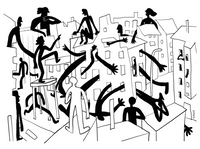
Illustration © Yorgos Konstantinou
Card Set Choreography & Urban Practice
Kartenset als Schnittstelle zwischen Choreographie & Urbaner Praxis
Download
Das Kartenset Choreographie & Urbane Praxis ist veröffentlicht, Ergebnis eines kurzen und intensiven Denklabors im Dezember 2022. Es lädt ein, über Stadtgestaltung aus choreographischer Perspektive nachzudenken. Zum Spielen, Ausprobieren, Weiterdenken!
The card set Choreography & Urban Practice is published! Result of a short and intensive Lab in December 2022. An invitation to think about urban design from a choreographic perspective. For playing, trying, taking further!
Denklabor Choreographie, Tanz und Urbane Praxis (Belasco Rogers, D., Chauchat, A., Hanna, S., Hoerster E., Konstantinou, Y., Kramer P., Münker K., Reuter, G., Seeger, S., Soldan & Zahn, S.) (2023): Kartenset Choreographie & Urbane Praxis. Selbstverlag. // Organisiert von/organized by: Eva-Maria Hoerster, Gabriele Reuter, Sabine Zahn
Texte über meine Arbeit
• Nachbar, M. (2025) Gemeinsam zu Fuß in der Stadt. Choreografien leibkörperlicher Raumkonstitution anhand partizipativer Gehperformances, in: repOS HCU Hamburg 2025 https://doi.org/10.34712/142.73 Anhand und mithilfe von ambulatorischen Projekten erforscht die Studie, welche Räume beim gemeinsamen Gehen in der Stadt konstituiert werden, wie die Teilnehmer*innen solcher Projekte diese Räume wahrnehmen und in der Bewegung des Gehens miteinander verknüpfen, und wie sie ihre Erfahrungen in Worte fassen. Die zentrale Frage der Untersuchung lautet: Wie durchlässig gestalten sich durch gemeinsames Gehen in der Stadt konstituierte Räume und deren Verknüpfungen, wie lassen sie sich wahrnehmen, und wie sprechen die Gehenden darüber, wenn sie von der Bewegung des Gehens aus gedacht und untersucht werden?
• Lepp, N. (2025) Mit der Welt bilden. Ökologien der Kulturellen Bildung im Anthropozän., in: KULTURELLE BILDUNG ONLINE
https://doi.org/10.25529/S3T9-CR80
Mit dem Begriff Anthropozän sind jenseits seiner erdgeschichtlichen Perspektive und Herkunft die zerstörerischen Auswirkungen menschlichen Handelns angesprochen, durch die der Mensch seine eigene Existenz gefährdet. Der Text fragt vor dem Hintergrund der Erfahrungen von Klimawandel und ökologischen Mehrfachkrisen nach einer Neuausrichtung der Kulturellen Bildung im Anthropozän. Welche Rolle kommt ihr in diesem Zusammenhang zu und wie kann sie dazu beitragen, dringend notwendige neue Weltbeziehungen zu erfinden? Wie können wir Kulturelle Bildung neu denken, damit sie dem „Leben auf einem beschädigten Planeten“ (Tsing 2017) gerecht werden kann? Der Text macht sich für eine Neuverortung der Kulturellen Bildung im Maßstab des Planetaren und einer damit verbundenen Logik der Relationalität stark und orientiert sich dafür an Theorieansätzen des Ecocriticism. Anhand von drei Verfahrensweisen – „Spekulieren“, „Rausgehen“, „Verkörperungen“ – skizziert er Ansätze und Aufgabenfelder einer ökokritischen Kulturellen Bildung, deren Selbstverständnis von einem Bilden mit der Welt statt einem Bilden über die Welt getragen ist.
Foto auf dieser Seite: C. Demarco